 Marcella Lombardini
 AI Agents in HR: Automating the Employee Lifecycle Without Losing the Human Touch
From CV screening to continuous learning, AI agents are transforming HR workflows — cutting time-to-hire, automating onboarding, and delivering personalized growth paths at scale.
HR teams are stretched thin. Recruitment alone spans job posting, CV screening, interview scheduling, candidate communication, and offer management — and that’s before the successful hire sets foot in the building. Then comes onboarding, training, performance cycles, absence tracking, and continuous development. Each of these areas demands significant human attention. The irony is that a great deal of that attention is not really human work at all — it’s administrative, repetitive, and rule-based. AI agents are beginning to absorb that load, and the early results for organisations that have deployed them are hard to ignore.
The HR Automation Paradox
HR is simultaneously the most human function in a business and the one most likely to drown its practitioners in administrative overhead. People-focused work — building culture, resolving conflict, developing talent, navigating difficult conversations — requires genuine human judgment, empathy, and presence. But in most organisations, HR professionals spend a disproportionate share of their week on tasks that have nothing to do with any of that: formatting job descriptions, chasing hiring managers for interview feedback, manually triggering onboarding workflows, and compiling absence reports.
The goal of AI in HR is not to automate human relationships. It is to eliminate the overhead that prevents HR from focusing on humans. When an agent handles the administrative layer, HR professionals get back the time and cognitive space to do what they were actually hired to do: help people succeed at work.
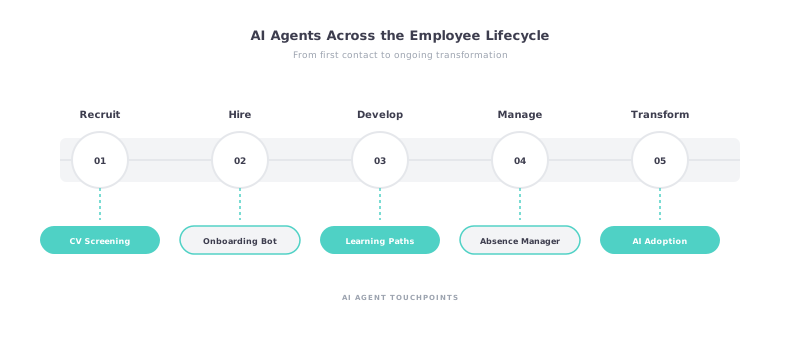
Where AI Agents Are Making the Biggest Impact
CV Screening and Candidate Evaluation
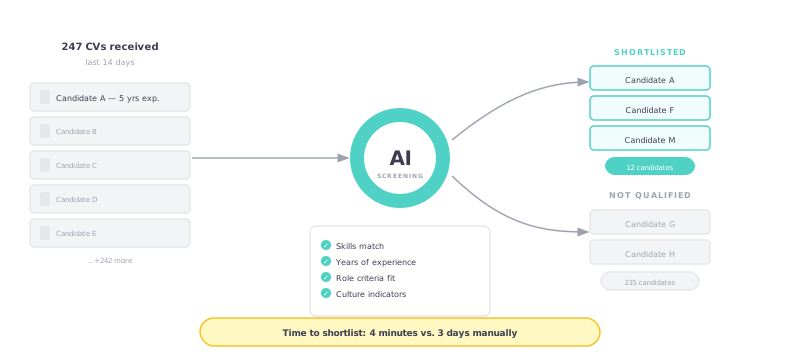
Traditional CV screening is either too slow (manual review at scale) or too crude (keyword matching that discards strong candidates). AI agents offer a third path. Rather than simply filtering by keywords, a well-configured screening agent evaluates candidates against the actual requirements of the role, the characteristics of your past successful hires in similar positions, and the current composition of the team they would be joining.
The output is not just a ranking. It is a structured evaluation report for each candidate — highlighting alignment with role criteria, flagging gaps, and surfacing questions worth exploring in interview. Hiring managers receive richer information faster, and the people who get screened out are screened out for documented reasons. For high-volume recruitment, the time saving is substantial. For specialist roles, the quality improvement is often even more significant.
Onboarding Orchestration
Onboarding failure is expensive and almost entirely preventable. When new hires don’t receive equipment on time, don’t get access to the systems they need, or feel lost in their first few weeks, the fault usually lies not with anyone’s intentions but with the coordination overhead of managing dozens of parallel tasks across IT, facilities, payroll, and the hiring team.
An onboarding agent changes this by becoming the single orchestrating layer. It triggers and tracks every step in the process — system access provisioning, equipment requests, compliance training enrolment, buddy assignments, and manager check-ins. It answers the new hire’s questions in plain language, guides them through internal tools and policies, and sends proactive nudges to anyone who has a pending action. Nothing falls through the cracks because the agent doesn’t forget, doesn’t get distracted, and doesn’t have a full inbox.
Absence and Leave Management
Absence management is a textbook example of high-volume, low-complexity work that consumes disproportionate HR time. Employees submit requests. HR checks eligibility, applies policy rules, updates records, notifies managers, and generates reports. The individual transactions are not difficult — they are just relentless.
An absence management agent handles all of this autonomously for routine cases. It checks the request against the employee’s entitlement, applies the relevant policy (including local jurisdiction rules where applicable), confirms with the employee, notifies the manager, and updates the record. HR is only drawn in for exceptions — disputes, patterns that warrant a conversation, or requests that fall outside standard policy. Monthly absence reports generate themselves.
Learning & Development
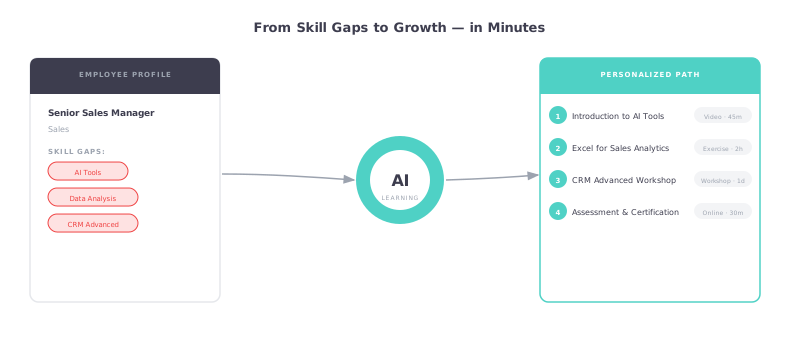
Personalised learning at scale has always been an aspiration that bumped into the reality of resourcing. Building individual development plans, curating content for each role and level, and creating training materials from scratch is time-intensive work that most L&D teams cannot deliver consistently across the organisation.
AI agents shift this equation. An L&D agent can analyse skills gap data against role frameworks, generate a tailored learning path for each employee, and surface relevant content from your existing knowledge base — internal documentation, previous training materials, recorded sessions, curated external resources. Where content gaps exist, the agent can generate structured learning materials: module outlines, assessments, scenario-based exercises. The L&D team moves from content production to content curation and quality review.
AI Adoption and Change Management
As organisations deploy more AI tools, a new HR challenge has emerged: driving adoption and managing the cultural change that comes with it. Resistance, confusion, and uneven uptake are common — and they undermine the return on the technology investment.
Agents can play a specific role here. An adoption support agent guides employees through new tools interactively, answers usage questions in context, and tracks engagement signals across the workforce. It surfaces resistance patterns early — which teams are not engaging, which roles seem to be struggling — giving HR and leadership the insight needed to intervene before adoption stalls. Change communications can be personalised and sequenced automatically based on where each team is in the rollout.
The Data Platform Behind HR AI
HR agents are only as good as the data they can access. A CV screening agent needs your job descriptions, competency frameworks, and historical hiring data. An onboarding agent needs your policy documents and the task definitions for each onboarding workflow. An L&D agent needs your skills framework, existing content library, and role profiles.
This is why the enterprise data platform is the foundation, not an afterthought. Without a well-structured, current, and accessible data layer, agents produce unreliable outputs. With it, they become significantly more accurate and useful over time.
Security and role-based access control are equally non-negotiable. An agent assisting a hiring manager cannot have visibility of existing employee salaries. An agent supporting a new hire cannot access confidential performance data about their colleagues. Permissions must be configured at the data layer, not just the application layer.
What About Employee Privacy?
This question comes up in every HR AI conversation, and rightly so. The short answer is that agents deployed in enterprise environments operate within your organisation’s Microsoft 365 tenant. They do not send data to external services. They respect the role-based access controls already configured in your environment. An agent that helps managers with performance reviews sees only what that manager is entitled to see.
Privacy by design means that the architecture itself enforces data boundaries — not policies that people might accidentally bypass, but technical constraints built into the system. When this is implemented correctly, AI agents in HR carry a significantly lower privacy risk than, for example, the informal sharing of information that happens in spreadsheets and email threads.
Getting Started: The Highest-ROI Entry Points
Related: Before scoping your first HR agent, read Why Enterprise AI Pilots Fail for a framework on defining metrics and avoiding the most common deployment mistakes. And for the broader context on agentic AI in 2025, see Beyond Chatbots: Why 2025 Is the Year of Agentic AI.
The most common mistake in HR AI adoption is trying to automate everything at once. The better approach is to start with one well-scoped agent, measure its impact, and use that evidence to build confidence and appetite for the next.
Three agents consistently deliver the fastest return for HR teams:
1. CV screening agent for high-volume recruitment. Even a modest reduction in screening time — say, cutting the review cycle from five days to one — has a measurable impact on time-to-hire and candidate experience. The output quality improvement is often an additional benefit.
2. Onboarding checklist and Q&A agent for new hires. This agent pays back its implementation cost quickly, reduces onboarding errors, and generates genuine goodwill with new employees. It also removes a consistent source of friction for HR coordinators and hiring managers.
3. L&D content generation agent to scale training materials. Particularly valuable for organisations that need to maintain compliance training, upskill employees on new tools, or build role-specific learning paths without a large L&D team.
Start with one. Measure time saved, error rates reduced, and employee satisfaction with the process. Then expand from a position of demonstrated value rather than projected potential.
The organisations getting the most from AI in HR are not the ones that automated the most. They are the ones that were clearest about what they wanted HR to stop doing — so that HR could do more of what only humans can.
See it in action.
Get your first agent scoped — at no upfront cost.