 Marcella Lombardini
 Shadow AI: The Silent Risk in Your Organization — and How Governed Agents Fix It
Employees are already using AI tools outside your control. Shadow AI is the new shadow IT — and it carries compliance, data, and reputational risks your business can't afford to ignore.
Your employees are already using AI. Whether you’ve sanctioned it or not.
Right now, across your organization, people are pasting contract summaries into ChatGPT, uploading spreadsheets to Gemini, feeding support tickets to Claude, and drafting client proposals with whatever tool they found last month. This isn’t speculation — it’s the baseline reality in almost every enterprise that hasn’t built a deliberate AI strategy. The tools are free, they’re fast, and they make people measurably more productive. That combination is irresistible.
The problem isn’t the productivity. The problem is that most of it is happening entirely outside your security perimeter, your data governance policies, and your compliance obligations — and most IT leaders still don’t have full visibility into it.
Shadow AI Is the New Shadow IT
Cast your mind back to the early 2010s. IT departments were fighting a losing battle against Dropbox, personal Gmail accounts, and consumer cloud storage. Employees were syncing company files to personal devices, sharing sensitive documents over WhatsApp, and bypassing corporate systems because the corporate systems were slower and more frustrating to use. That was shadow IT.
Shadow AI follows exactly the same pattern — with one critical difference. When an employee stored a file in Dropbox, the file sat there. When an employee pastes that same file into a consumer AI tool, the content is actively processed by a third-party model, potentially stored in training pipelines, and handled under terms of service that were written for consumers, not enterprise compliance teams.
The scale is also different. Shadow IT spread gradually. Shadow AI spread instantly, because the tools are genuinely useful from day one and require no installation. According to multiple enterprise surveys, a significant majority of knowledge workers report using AI tools at work that their employer hasn’t officially approved. In most organizations, the audit hasn’t even started yet.
The Real Risks of Uncontrolled AI Use
Data Leakage
The most immediate and tangible risk is data leakage. Employees routinely paste sensitive material into consumer AI tools: customer contracts, financial forecasts, HR records, acquisition analysis, source code, regulatory filings. The reasoning is always innocent — they just want to summarize, reformat, or improve a document.
Most consumer AI tools, unless specifically configured in an enterprise tier, use input data to improve their models. That means confidential information your employee pasted this morning could theoretically inform model outputs for other users. Even in cases where a vendor claims not to train on inputs, the data has still left your network, traversed external infrastructure, and is subject to the vendor’s data handling practices — not yours.
Compliance Exposure
GDPR is explicit: if personal data belonging to EU residents is transferred to a third party, there must be a legal basis for that transfer, appropriate safeguards, and contractual data processing agreements. Most consumer AI tools don’t have those agreements with your organization. The employee who uploaded a customer list to improve a marketing campaign didn’t consult legal — and why would they? They were just trying to get their job done.
Beyond GDPR, industry-specific regulations add further complexity. Healthcare organizations face HIPAA exposure. Financial services firms face FCA and SEC scrutiny. Any organization with contractual NDAs faces potential breach the moment confidential third-party information touches an unsanctioned AI service.
Inconsistent Outputs
Governance isn’t only about security. It’s also about quality and consistency. When every employee is using a different AI tool with a different prompt strategy, the outputs vary wildly. Two analysts running the same competitor analysis might reach opposite conclusions depending on the tool, the model version, and the prompt they happened to write.
There’s no audit trail, no version control, and no way to reconstruct what data informed what decision. In a regulated environment, that’s not a theoretical problem — it’s a liability.
Reputational Risk
AI tools hallucinate. They generate confident-sounding text that is factually wrong. When that text is used in a client deliverable, a press release, or a public-facing document, and no governance process caught it before publication, the reputational consequences fall on your organization — not on the AI tool your employee happened to use.
A single embarrassing AI-generated output, publicly attributed to your brand, can undo months of trust-building. The risk scales with adoption — and right now, adoption is already far ahead of governance.
Why Banning AI Doesn’t Work
If the risks are this clear, why not simply prohibit the use of consumer AI tools at work?
Because blanket bans don’t eliminate the behavior — they just drive it underground. Employees who have experienced the productivity gains of AI assistance will not willingly return to doing everything manually. They’ll use personal devices on personal networks, they’ll work from home and use tools their employer can’t see, and they’ll quietly resent a policy that treats them as a threat rather than a resource.
History backs this up. The same happened with Dropbox. The same happened with WhatsApp. The tools that employees used despite the ban were eventually replaced — not by harsher enforcement, but by better, employer-sanctioned alternatives that met the same need within a controlled environment.
The only sustainable answer to shadow AI is to give employees a better alternative they’re actually permitted to use.
How Enterprise AI Agents Eliminate Shadow AI
Enterprise AI agents built within the Microsoft 365 perimeter give employees the AI capability they’re looking for — with governance built in from the start rather than bolted on after the fact.
An agent operating inside the M365 ecosystem accesses only the data it has been explicitly authorized to access. It respects Azure Active Directory roles and permissions. It cannot reach outside the organizational boundary to consume or transmit data. Its outputs are generated within a controlled environment and can be logged, reviewed, and audited.
From the employee’s perspective, the experience is seamless — they get fast, intelligent assistance with their actual work tasks. From IT’s perspective, every agent interaction is governed, visible, and compliant. The shadow AI incentive disappears because the sanctioned alternative is better.
The Governance Framework That Makes It Sustainable
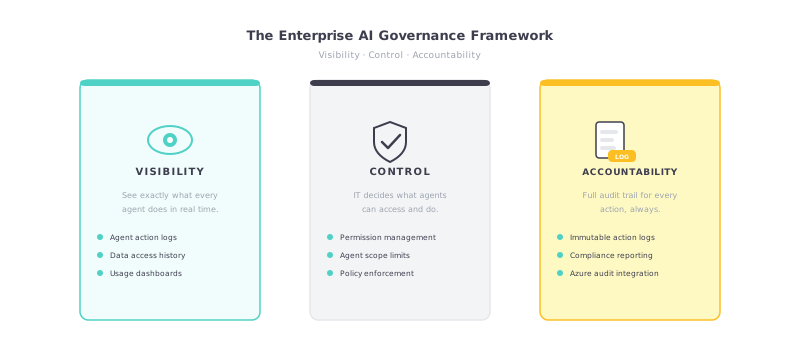
Deploying governed agents isn’t just a technical decision — it’s a governance posture. And that posture rests on three pillars.
Visibility is the foundation. You need to know what your AI agents are doing: what data they accessed, what prompts were submitted, what outputs were produced, and by whom. Without visibility, you cannot demonstrate compliance, identify anomalies, or learn how your agents are actually being used. A real-time governance dashboard makes all of this available without requiring manual audits.
Control is what makes visibility actionable. IT should own the deployment, configuration, and permissioning of every agent in the organization. New agents should go through an approval process. Data access scopes should be reviewed before deployment. The ability to suspend or modify an agent should sit with your security team, not with a third-party vendor’s SLA.
Accountability closes the loop. Every agent action should produce an immutable audit log that answers the question: what happened, with what data, and when? This is not just about incident response — it’s about being able to demonstrate compliance to a regulator, a client, or a board that asks.
From Shadow AI to AI Strategy
Related: Understanding why most enterprise AI pilots fail before they reach scale is key context here. Read Why Enterprise AI Pilots Fail — And the Pay-Per-Action Model That Changes Everything, and Beyond Chatbots: Why 2025 Is the Year of Agentic AI for a broader picture of where enterprise AI is headed.
The conversation about shadow AI is easy to frame as a risk management issue — because it is one. But it’s also something more. The organizations that get ahead in the next five years won’t be the ones that banned AI the longest. They’ll be the ones that moved fastest from uncontrolled shadow usage to deliberate, governed AI strategy.
When AI use is governed, it becomes measurable. When it’s measurable, it becomes improvable. When it’s improvable, it becomes a genuine competitive advantage — not just a productivity tool, but a strategic capability that compounds over time.
The governance conversation isn’t a constraint on AI adoption. It’s the foundation that makes real adoption possible.
If you’re already seeing signs of shadow AI in your organization — or simply know it’s happening without visibility — the right time to build the governance framework isn’t after an incident. It’s now.
See it in action.
Get your first agent scoped — at no upfront cost.