 Giuseppe Marchi
 Beyond Chatbots: Why 2025 Is the Year of Agentic AI in the Enterprise
The era of passive AI assistants is over. In 2025, enterprise AI means agents that retrieve, reason, produce, and act — autonomously, inside your systems, with measurable results.
For three years, enterprise AI was synonymous with chatbots. Every major platform vendor shipped one. Every digital transformation roadmap included one. Procurement teams evaluated them against each other. And then, quietly, the results came in.
Most enterprises were disappointed. The chatbots answered generic questions well enough. They failed at everything that actually mattered: connecting to live company data, taking actions inside business systems, working without constant supervision, and delivering outcomes that showed up on a balance sheet.
2025 is different — not because AI improved marginally, but because the architecture changed. The shift from passive assistants to autonomous agents is not a product update. It is a structural change in what enterprise software can do.
The Chatbot Trap
To understand why agents are different, it helps to be precise about what chatbots got wrong.
Enterprise chatbots were built on a fundamentally limited model: a user asks a question, the system searches for relevant content, and returns a text response. The quality of the answer depended entirely on what was in the knowledge base — and knowledge bases are, almost universally, incomplete, outdated, and inconsistently maintained.
More critically, chatbots could not do anything. They could describe a process but could not execute it. They could tell you how to submit an expense report but could not submit it. They could retrieve a document but could not summarise it, compare it to another, or flag a clause that contradicted company policy.
They were, in the most accurate sense, expensive search engines with a conversational interface. The ROI was always going to be limited, because the value ceiling was baked into the architecture.
Enterprises that bought into the chatbot wave did not make a bad decision — the technology was genuinely useful for narrow FAQ automation. But those who expected chatbots to deliver meaningful process automation were asking the wrong tool to do a job it was never designed for.
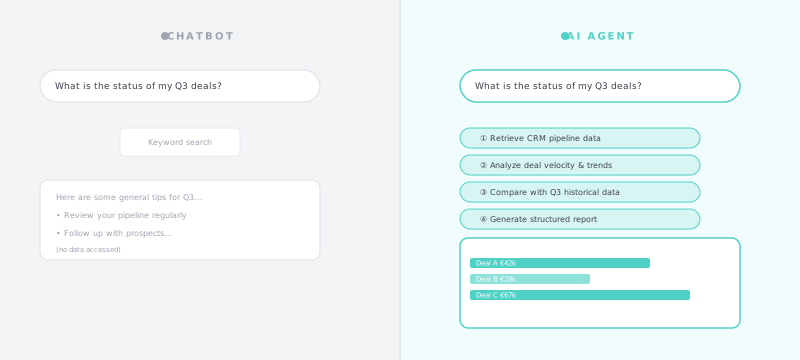
What Makes an Agent Different from a Chatbot
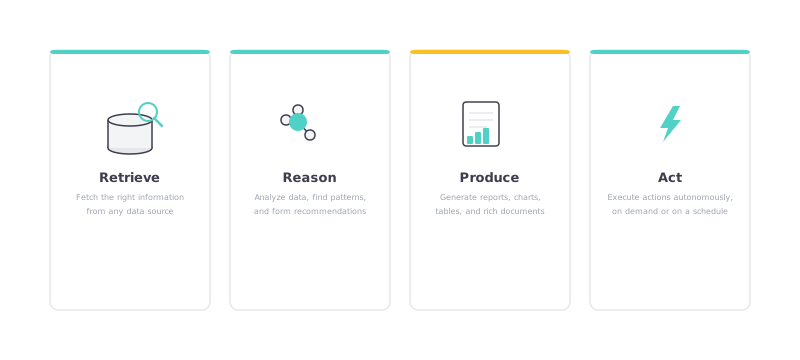
An agent is defined not by its interface but by its capabilities. There are four that matter, and together they represent a qualitative leap over anything a chatbot could do.
Retrieve
An agent does not search — it retrieves. The distinction matters. Search returns documents ranked by keyword relevance. Retrieval means understanding what information is actually needed, knowing where it lives across structured databases, unstructured documents, emails, and SharePoint sites, and pulling precisely the right context for the task at hand.
Modern agents use semantic understanding to work across heterogeneous data sources simultaneously. They do not care whether the answer is in a SQL table, a PDF stored in SharePoint, or an email thread from six months ago. They find it, evaluate its relevance, and use it — all in real time, within your secure environment.
Reason
Retrieval without reasoning is just faster search. What separates an agent from a retrieval system is its ability to do something with the information it finds.
An agent can analyse a dataset and surface the three anomalies that a finance controller should review. It can compare this month’s contract terms against a standard template and flag deviations. It can read fifty support tickets, identify a pattern that suggests a recurring infrastructure issue, and write a summary for the operations team. It synthesises. It evaluates. It generates conclusions — and it can explain how it reached them.
This is not artificial intelligence as a metaphor. It is the practical capability to compress hours of analytical work into seconds, consistently, without fatigue.
Produce
An agent does not just answer — it creates. The output of an agentic workflow can be a structured report formatted to your company’s template, a chart showing pipeline velocity over the last quarter, a draft email ready for review, a populated contract with fields pulled from a CRM record, or a risk assessment document formatted for a board meeting.
The shift from text responses to rich, actionable outputs is what makes agents genuinely useful to knowledge workers. The output does not need to be reformatted, rewritten, or rebuilt before it can be used. It arrives ready.
Act
This is the capability that defines agentic AI and distinguishes it completely from everything that came before. An agent can execute actions inside your business systems — on request, or autonomously on a schedule.
It can create a ticket in your ITSM platform when it detects a threshold breach. It can send a notification to a manager when a contract is due for renewal. It can update a record in Dynamics or Salesforce after completing an analysis. It can provision a Microsoft 365 licence, schedule a meeting, or trigger an approval workflow — without a human in the loop.
The phrase “on a schedule” is worth pausing on. An agent can run a weekly pipeline analysis every Monday at 07:00, deliver the output to your sales director’s inbox, and flag any deal that requires attention — before the weekly review meeting. Without anyone pressing a button.
The Enterprise Use Cases Leading the Adoption Curve in 2025
Agentic AI is not uniformly mature across enterprise functions. Some areas are seeing real, measurable ROI right now. Others are earlier stage. Here is where the evidence is strongest.
IT support is the most mature category. L1 ticket automation — where an agent handles password resets, access provisioning, account unlocks, and basic troubleshooting autonomously — is delivering 35–55% autonomous resolution rates in live deployments. The ROI is calculable from day one.
HR and talent operations is the second most active area. CV screening, structured shortlisting, onboarding checklist automation, and policy Q&A for employees are all within scope for agents operating today. Organisations running high-volume recruitment are seeing time-to-shortlist drop by 60–70%.
Sales operations is where agents are starting to prove their value in revenue-generating processes. Pipeline analysis, forecast modelling, deal risk scoring, and competitive brief generation are all tasks that agents handle well — and that historically consumed hours of sales operations time per week.
Finance and reporting is particularly strong for agents with structured data access. Automated month-end reporting, variance analysis, budget versus actuals commentary, and audit-ready document generation are real workflows that finance teams are running with agents today.
Legal and compliance is earlier in the adoption curve but moving fast. Contract review, clause extraction, policy gap analysis, and regulatory change monitoring are use cases where the combination of retrieval, reasoning, and production delivers clear value — and where the cost of missing something is high enough to justify the investment.
The New Architecture: Agents + Data Platform
One of the most important — and least discussed — truths about enterprise AI is this: agents are only as good as the data they can access.
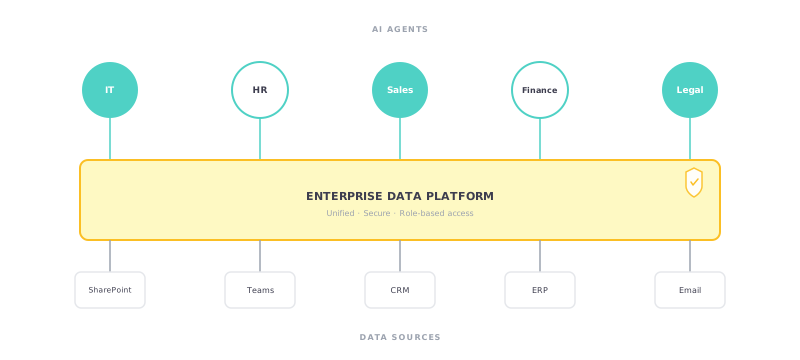
A sophisticated agent connected to fragmented, siloed, or incomplete company data will underperform an average agent with unified, well-structured access to everything. The data architecture is not a pre-requisite to sort out someday. It is the foundation that determines the ceiling on every agent you deploy.
The enterprises making the most progress with agentic AI in 2025 are building or buying what some call a “data platform” or “second brain” — a unified, secure layer that gives agents structured access to all company information: SharePoint, email, databases, CRM records, financial systems, HR data. Not a data lake. Not a search index. A queryable, permissioned knowledge layer that agents can retrieve from in real time.
The combination of a well-designed data platform and purpose-built vertical agents is what separates organisations that are extracting real value from AI from those still running proof-of-concept projects with no production deployment in sight.
What Enterprises Get Wrong About AI Agent Deployment
Three mistakes account for the majority of failed or stalled agentic AI projects.
Building generic assistants instead of vertical specialists. A general-purpose AI assistant that can “help with anything” does nothing particularly well. The agents delivering ROI are narrow by design: one agent for L1 IT support, one for contract review, one for sales pipeline analysis. Depth of expertise beats breadth of coverage every time. A vertical agent built on domain-specific data, trained on the specific workflows it executes, and measured against precise metrics will outperform any general assistant in its target domain.
Ignoring governance. Who controls the agent? What data can it access? What actions can it take autonomously versus which require human approval? What audit trail exists for its decisions? These questions are not afterthoughts — they are the architecture. Organisations that deploy agents without a governance framework discover the problem when an agent takes an unintended action or when compliance asks for a log of automated decisions that does not exist. Governance should be designed before the first line of code is written.
Deploying AI without defining success. This is the most common and most damaging mistake. An AI deployment without agreed metrics is an AI deployment that will fail to demonstrate ROI — not because it does not deliver value, but because no one can prove that it does. Before any agent goes live, define the three or four metrics that will be tracked, how they will be measured, and what the target is. Make those metrics visible in a real-time dashboard. Report against them every month. If you cannot describe what success looks like before you start, you will not be able to tell when you have achieved it.
The Right Starting Point
Related: For concrete examples of agentic AI in action, see How AI Agents Are Quietly Eliminating Your IT Support Backlog and How AI Sales Agents Are Closing the Gap Between Pipeline Data and Revenue.
If you are at the beginning of an agentic AI strategy, resist the impulse to map out a five-year transformation programme before you have deployed anything.
Start with one process. Choose it on two criteria: high volume and high repetition. The economics of agentic AI are strongest where the same task runs at scale — because the agent’s performance compounds against a large number of events, not a small one.
Define the metrics before you start building. Not after. Agree on what the agent will be measured against, what a successful deployment looks like at 30 days and at 90 days, and who will review the numbers.
Then deploy, measure, and iterate. The organisations that are furthest ahead in 2025 did not start with the most ambitious roadmap. They started with the highest-confidence use case, built the habit of measuring, and expanded from there.
The era of enterprise AI as a strategic aspiration is over. In 2025, it is a question of which processes you automate first — and whether you have the measurement infrastructure to prove what it is worth.
See it in action.
Get your first agent scoped — at no upfront cost.