 Giuseppe Marchi
 How AI Sales Agents Are Closing the Gap Between Pipeline Data and Revenue
CRM data is only valuable if someone acts on it. AI sales agents analyze your pipeline, spot at-risk deals, generate forecasts, and handle the back-office work your sales team hates.
Sales teams collect enormous amounts of data. Every call, every email, every stage progression, every deal won and lost — it’s all in the CRM, in theory. The problem is that knowing it’s there and actually using it are two different things. Reps don’t have time to analyse their own pipeline. Managers are working from last week’s snapshot. Forecasts are built on gut feel dressed up as data. Follow-ups get missed not because salespeople don’t care, but because the volume of concurrent activity makes it nearly impossible to track everything manually.
AI sales agents are changing this dynamic — not by replacing salespeople, but by handling everything that isn’t selling. The result is a sales operation that is simultaneously more informed and faster to act.
The Sales Data Problem
Most companies have CRM data that is simultaneously incomplete, stale, and siloed. Reps log what they remember when they get a moment. Contacts go months without an update. Deal stages reflect where a conversation was three weeks ago, not where it is today. The data warehouse that was supposed to be your single source of truth has become an unreliable record of what people intended to happen.
The root cause is not laziness. It is time. Research consistently shows that salespeople spend 30 to 40 percent of their working hours on non-selling activities: logging calls, writing proposals, updating records, preparing reports, chasing internal approvals, and managing post-sale documentation. Every hour spent on administration is an hour not spent in front of a customer. When data entry feels like bureaucracy rather than a tool that helps reps sell, the data quality suffers — and with it, every forecast and pipeline review built on top of it.
This is the problem space AI agents address directly.
Four Ways AI Agents Transform Sales Operations
Pipeline Analysis and Deal Intelligence
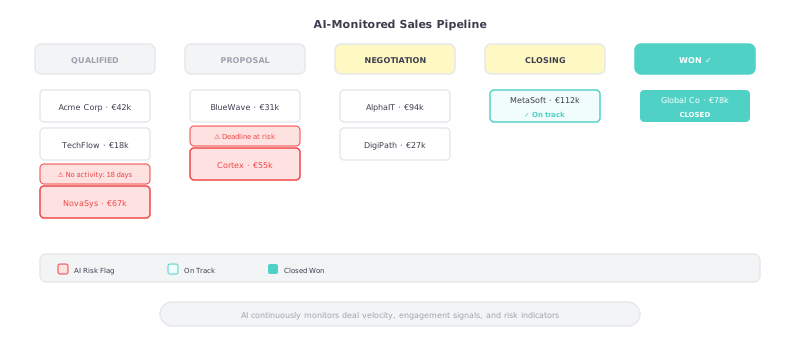
A pipeline analysis agent does not wait for the weekly review meeting to tell you that a deal is at risk. It monitors your CRM data continuously — deal velocity, stage progression, engagement frequency, response times, and comparison against historical patterns for similar deals at similar stages.
When something looks off, the agent flags it proactively and explains why. A deal that stalled at the proposal stage for longer than your average close time. A key stakeholder who hasn’t responded in two weeks after previously being highly engaged. A competitor mention in the notes that never generated a response plan. These signals exist in your data today — they just aren’t surfaced because no one has the bandwidth to look.
The agent surfaces them in time to act, not after the deal has quietly died.
Sales Forecasting and Trend Analysis
Revenue forecasting is one of the most consequential activities in a business and one of the least scientific. Most forecasts blend pipeline data with manager intuition, historical memory, and varying degrees of optimism. The result is forecasts that are often wrong in predictable ways — consistently overestimating close rates in Q3, consistently missing the long tail of smaller deals.
A forecasting agent replaces this with a structured, data-driven approach. It combines current pipeline data with historical close rates segmented by deal size, sector, rep, and stage. It applies seasonal patterns. It accounts for the velocity of current deals relative to what has closed before at the same point in the cycle. Revenue leaders get a forecast built on evidence, updated continuously, with explicit confidence intervals rather than a single number that conceals its own uncertainty.
When the data changes — a large deal slips, a new opportunity enters at late stage — the forecast updates automatically.
Back-Office Automation
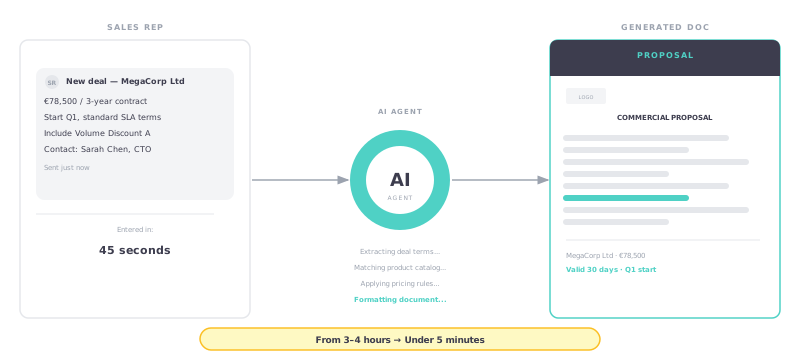
Proposal writing, quote generation, order confirmation, post-sale documentation — these are tasks that require information the sales team already has, assembled into formats that follow predictable structures. They are exactly the kind of work that should not require a senior rep to spend two hours on a Wednesday afternoon.
A back-office automation agent changes this. The rep describes the deal in plain language — the product configuration, the pricing tier, the customer’s specific requirements, the timeline. The agent produces the proposal draft, applies the correct pricing from the catalogue, formats the document to your template, and flags anything it couldn’t resolve automatically. What previously took hours takes minutes. The rep reviews, refines, and sends.
The same logic applies to post-sale handover documents, renewal summaries, and weekly pipeline reports for management. If the structure is predictable and the data exists, an agent can produce it.
CRM Data Quality and Enrichment
Clean CRM data is a precondition for everything else on this list. A pipeline analysis agent is only as good as the data it analyses. A forecasting agent that works from stale deal records will produce stale forecasts.
A data quality agent attacks this problem from two directions. First, it monitors records proactively — identifying contacts with no recent activity, deals with missing fields, accounts with outdated information — and prompts the relevant rep to update after each interaction. Second, where data can be enriched from available internal sources — email exchanges, meeting notes, linked documents — the agent does so automatically, without asking the rep to do anything.
Over time, the CRM becomes more reliable because maintaining it is no longer purely a manual burden. The agent carries the overhead.
The Integration Layer
None of this works in isolation. A sales agent needs to connect to your CRM, your product catalogue, your pricing engine, your proposal templates, and your communication tools. The more fragmented these systems are, the harder the agent’s job becomes.
This is why the enterprise data platform matters. A unified, secure layer that the agent can query — rather than a collection of disconnected systems with their own access models — is what allows the agent to produce coherent, accurate outputs rather than partial answers from the one system it happens to have access to. The platform is the infrastructure. The agent is what makes the infrastructure useful in practice.
What Sales Leaders Actually Get
The shift that AI sales agents enable is a move from discussing what the data might say to knowing exactly what it says — and acting on it before the window closes.
The concrete outcomes look like this: proposal generation time drops from several hours to under thirty minutes. Pipeline reviews shift from a weekly manual exercise that consumes half a day to a continuous automated feed that surfaces issues in real time. Forecast accuracy improves because the inputs are cleaner and the methodology is consistent. Reps reclaim time previously lost to administration and redirect it toward customer conversations.
These are not speculative benefits. They are the natural consequence of removing the friction that currently sits between your data and the decisions that data should be driving.
The Right First Agent for Sales
Related: The pay-per-action model that makes this deployment risk-free is explained in detail in Why Enterprise AI Pilots Fail — And the Pay-Per-Action Model That Changes Everything. For the broader picture of agentic AI in enterprise, see Beyond Chatbots: Why 2025 Is the Year of Agentic AI.
If you are choosing where to start, the pipeline analysis and deal intelligence agent is the clearest entry point. The value is immediately visible — deals flagged, revenue impact of rescued opportunities, adoption data showing which reps are engaging with the alerts. Leadership can see the return directly, which makes the case for expanding to forecasting, back-office automation, and CRM enrichment straightforward.
The implementation scope is manageable. You need CRM connectivity, access to historical deal data, and a clear definition of what “at-risk” means for your business. That is a scoped project, not a multi-year transformation.
Start with the pipeline. Measure what gets flagged. Track what gets rescued. Build from there.
See it in action.
Get your first agent scoped — at no upfront cost.