 Miro Radenovic
 Why Enterprise AI Pilots Fail — And the Pay-Per-Action Model That Changes Everything
Most enterprise AI projects stall after the pilot. The root cause is almost always the same: misaligned incentives, invisible ROI, and upfront costs that kill momentum before value is proven.
A significant percentage of enterprise AI pilots never make it to production. Estimates vary, but the consistent finding across analyst reports and post-mortems is that somewhere between 50% and 80% of enterprise AI initiatives either stall, get quietly deprioritized, or are formally cancelled before they deliver measurable value at scale.
This isn’t because the technology doesn’t work. Modern AI is genuinely capable of automating complex knowledge work tasks, improving consistency, and reducing per-unit costs in meaningful ways. The failure isn’t technical.
It’s structural. The way most enterprise AI pilots are funded, measured, and contracted makes it nearly impossible to demonstrate the value they’re generating — and without visible value, projects die the moment a budget cycle turns or a champion changes roles.
The Anatomy of a Failed AI Pilot
The pattern repeats with remarkable consistency across industries and company sizes.
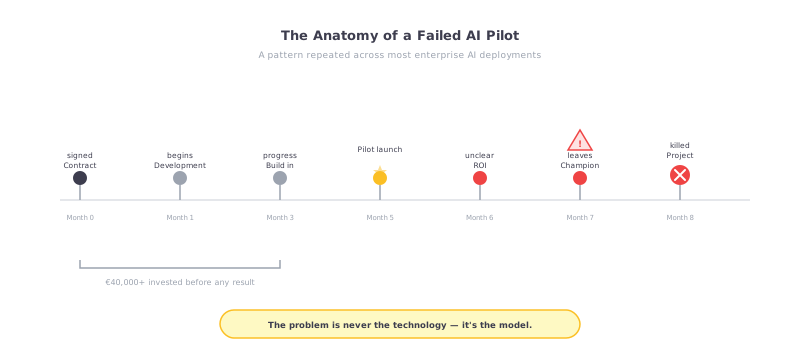
A business unit identifies a high-friction process — maybe it’s first-line IT support, or contract review, or monthly reporting. Leadership gets excited about AI. A vendor is engaged. A scope is agreed. A budget is allocated. And then the familiar sequence begins.
Development takes three to six months. The pilot deploys to a subset of users. Initial feedback is broadly positive — people find it useful, it saves some time, the outputs are generally good. But when the budget review arrives and someone asks for the business case, the numbers don’t tell a clear story. “Users find it helpful” isn’t a budget justification. “We think it’s saving about an hour per week per user” isn’t a business case. The project champion, who drove the initiative and understood its potential, moves to a different role. And six months after that, the pilot is quietly discontinued.
The technology worked. The project still failed.
Three Root Causes of Pilot Failure
Misaligned Incentives
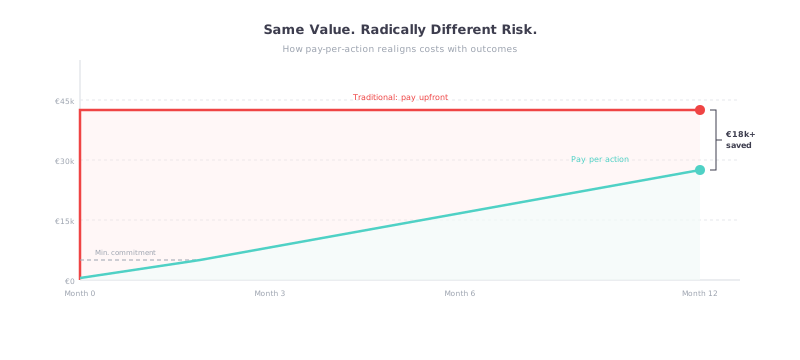
Traditional consulting and software development engagements are paid upfront. The vendor invoices for design, development, and deployment. Once those invoices are paid and the system is delivered, the vendor’s financial interest in the outcome largely ends.
This creates a fundamental misalignment. The client needs the solution to deliver measurable value to justify continued investment. The vendor has already been paid regardless. There is no financial pressure on the vendor to optimize for outcomes — only to deliver a working system, which is a much lower bar than delivering a system that demonstrably pays for itself.
Nobody in this model is lying or acting in bad faith. The incentive structure simply doesn’t require vendors to think hard about whether their solutions will generate real business value, because they get paid either way.
Invisible ROI
Pilots routinely deploy without pre-agreed metrics. This sounds like a minor process failure, but it’s actually the single most reliable predictor of whether a project will survive a budget review.
If you don’t define what “success” looks like before you build, you have no baseline to measure against after you deploy. You can’t demonstrate ROI if you didn’t measure the status quo. You can’t quantify time saved if you didn’t track how long the process took manually. You can’t show cost reduction if you never established what the process cost.
By the time the budget conversation arrives, the project team is in an impossible position: they believe the tool is creating value, but they can’t prove it in numbers, and “we believe it’s helping” won’t survive finance scrutiny in a year where every cost line is being reviewed.
The Proof-of-Concept Trap
There’s an important distinction between proving that AI can do something and proving that it will deliver value at scale. Most enterprise pilots are designed to answer the first question — and then discover, too late, that answering the first question doesn’t actually answer the second.
A proof of concept that works for 20 users in a controlled environment is not the same as a production system handling thousands of interactions, integrating with live data sources, operating under security and compliance constraints, and generating auditable outputs. Getting from PoC to production typically requires re-architecture, deeper integration work, governance infrastructure, and change management — none of which are budgeted into the pilot.
So the pilot succeeds on its own terms. It demonstrated the technology works. But scaling it requires a second, larger investment — and at that point, the business case is still unproven, because the pilot was never designed to prove it.
What a Successful AI Deployment Looks Like
The deployments that make it to production and generate lasting ROI share a common set of characteristics that distinguish them from the failure pattern.
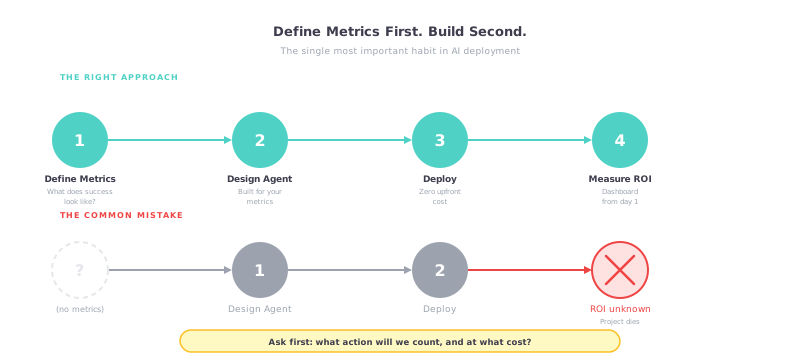
Metrics are defined before development starts. Not vague directional goals, but specific, measurable KPIs: tickets resolved per day, time from submission to output, hours of manual review eliminated per month. These metrics define what the agent will be optimized for — and they become the basis for the ROI calculation.
The deployment model aligns vendor incentives with outcomes. Rather than paying for development, the client pays for results. The vendor’s revenue is tied to the volume of value delivered, which means the vendor has a direct financial interest in making sure the agent works well, continuously improves, and scales.
Governance makes ROI visible in real time. A dashboard that tracks agent activity, output volume, and cost-per-action means that the ROI conversation is always grounded in current data — not in post-hoc estimates reconstructed from memory.
The path from pilot to scale is built into the contract. Volume tiers, pricing at scale, and governance infrastructure are designed from day one — not discovered as a surprise when the pilot succeeds and someone asks what it would cost to roll out company-wide.
The Pay-Per-Action Model: Incentive Alignment by Design
The pay-per-action model addresses the root cause of pilot failure at the structural level. Instead of paying for the development of an AI solution, you pay for the outcomes it delivers.
Every agent is defined by a specific, agreed action: a support ticket resolved, a document summarized and filed, a candidate screened, a report generated. The price per action is agreed upfront. You pay per unit of value delivered.
A minimum commitment covers the cost of development and deployment — this is the equivalent of a project setup fee, but one that scales down as volume increases rather than sitting as a fixed sunk cost. Above the minimum, you pay based on actual usage. At higher volumes, per-action costs decrease, reflecting the economics of scale.
The effect on incentive alignment is direct. The vendor only generates revenue above the minimum by delivering value that users actually consume. If the agent is unreliable, slow, or produces outputs that users reject, volume stays low and revenue stays low. The vendor’s commercial interest becomes identical to the client’s operational interest: make the agent as effective as possible.
Defining the Right Metrics Before You Build
The discipline of defining metrics before development begins isn’t bureaucracy. It’s what separates AI pilots that scale from AI pilots that die.
Consider an HR screening agent. Before writing a single line of configuration, you need to answer: what does success look like? Is it time-to-shortlist — how quickly does a hiring manager have a ranked candidate list after a role closes? Is it quality of candidates who proceed to interview, measured against ultimate hire rate? Is it recruiter hours saved per role?
Each answer leads to a different agent design. An agent optimized for speed will behave differently from one optimized for candidate quality. An agent designed to save recruiter time will have different integrations and output formats than one designed to improve hiring manager satisfaction. Getting the metric right before you build means you’re building the right thing — and that you’ll be able to prove it worked when the question is asked.
This process also surfaces misaligned expectations early, when they’re cheap to address. If the business unit wants time-to-shortlist reduced but the recruiting team cares most about candidate quality, that tension needs to be resolved before the agent is built — not discovered when the pilot review finds that the agent improved one metric while degrading another.
The Governance Dashboard as a Forcing Function
When ROI is visible in real time, the conversation with leadership changes completely.
Instead of standing in front of a budget committee saying “we think the AI is helping,” you can open a dashboard and show: the agent resolved 847 tickets last month at €1.50 each, saving approximately 212 hours of L1 support time at an average loaded cost of €35 per hour. That’s a €7,420 saving for €1,270 in agent costs. A 5.8x return, updated daily.
That’s a conversation that doesn’t require trust. It doesn’t require the budget committee to believe in AI or the project champion’s instincts. It’s a calculation they can verify, model forward, and use to make a rational investment decision.
The governance dashboard also functions as an early warning system. If the agent’s resolution rate drops — because a system it depends on changed, or because the types of requests it’s receiving shifted — you see it immediately and can intervene. You’re not discovering six months later that the ROI story you told no longer reflects reality.
Starting Right: Three Questions to Ask Before Any AI Deployment
Related: See how these principles apply in practice — How AI Agents Are Quietly Eliminating Your IT Support Backlog is a concrete case of a scoped, measurable deployment. And if ungoverned AI use is part of your problem, Shadow AI: The Silent Risk in Your Organization covers the governance side.
Before you engage a vendor, run a pilot, or allocate a budget line, three questions will tell you whether a deployment is likely to succeed.
What specific action will this agent take, and how will we count it? If you can’t describe the agent’s output in a single sentence and explain how you’d count instances of that output, the scope is too vague to deploy against.
What is the measurable current cost of doing this manually? This is your baseline. Time, headcount, error rate, delay — whatever matters. Without this number, ROI is unprovable. With it, ROI becomes a straightforward calculation.
What is the minimum volume we’d need to justify the governance investment? Even pay-per-action models have setup costs. Understanding the break-even volume before you start tells you whether the use case is commercially viable at your scale — and saves you from running a technically successful pilot that nonetheless can’t justify its own existence.
The companies that consistently get value from AI aren’t the ones with the most sophisticated models. They’re the ones with the clearest metrics, the most aligned incentive structures, and the governance infrastructure to prove what’s actually happening. That combination is rarer than it should be — but it’s entirely replicable.
See it in action.
Get your first agent scoped — at no upfront cost.